

Last week, I wrote about how one way to actually make progress on our goals is to start with something stupidly simple. What I didn’t get into is how wildly hard that can be—especially for high-achievers, overthinkers, and spreadsheet optimizers (hi, it’s me 😅). We tend to skip the “simple” step and head straight into full-blown renovation mode. And then promptly burn out.
Take strength training. I knew it was important. I wanted to make it a habit. So, naturally, I dove headfirst into research, watched hours of YouTube, read blogs, discovered Andy Galpin, and built a beautifully color-coded, science-backed 4x/week routine.
And I did it! For about six weeks.
Then I realized… I was dragging myself through each session, checking off sets like chores, and slowly growing resentful. Which was weird, because I actually like moving my body. Just… not like this.
And the truth? I needed to step back because I had designed something for an idealized version of myself and not the real me, with limited energy, shifting priorities, and a low tolerance for things I secretly dread.
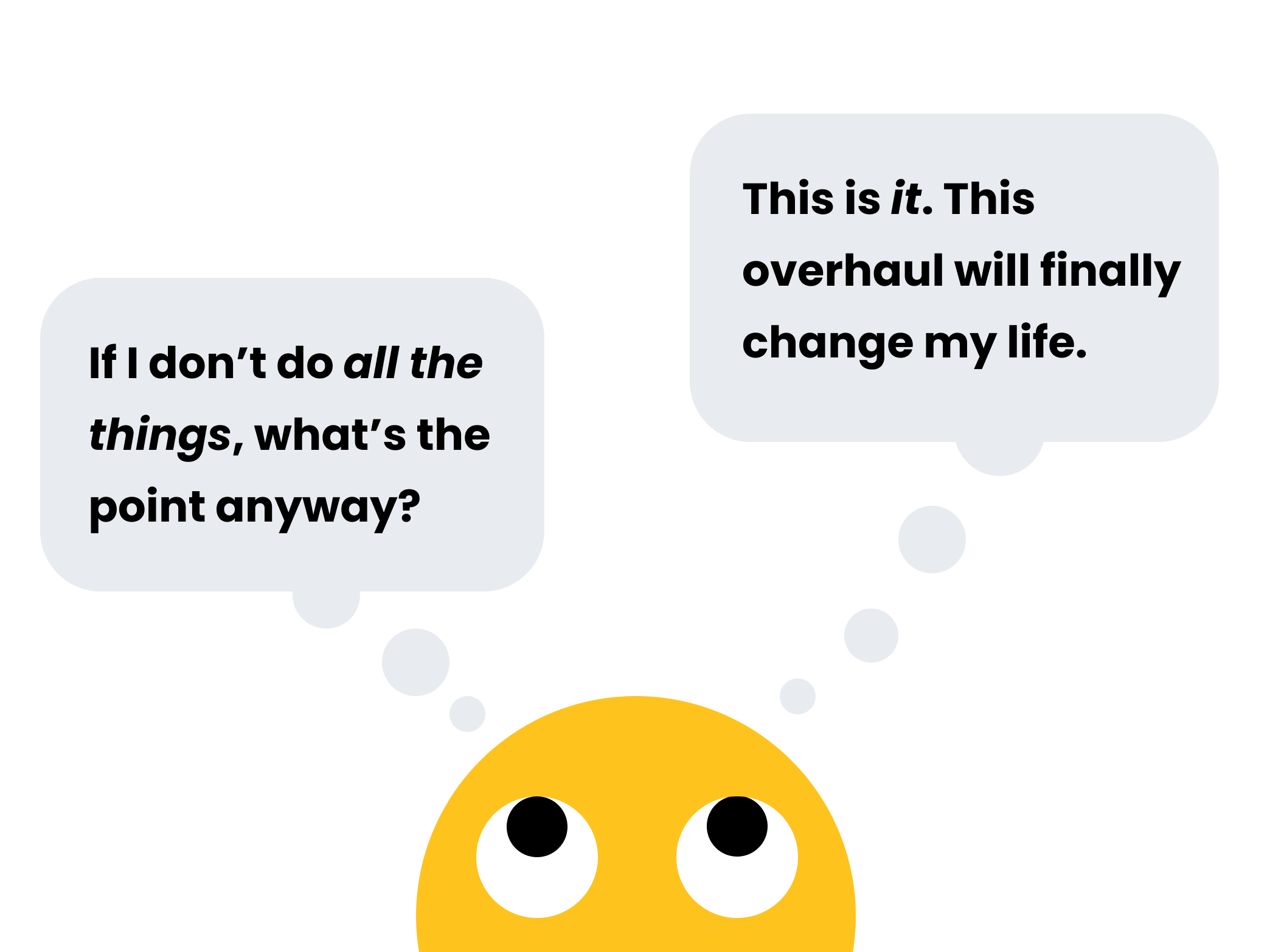
Why do we go all in?
We have many mental models ingrained in our brains that lead us to chase the perfect plan. That’s just human. Being aware of these patterns can help us pause before falling into them (not always, but it’s a start).
Here are a few of the common ones to be aware of:
All-or-Nothing Thinking
This mindset equates success with maximum effort. Anything less than 100% feels like failure, which makes starting small feel pointless, and slipping up feel catastrophic.
Identity Investment
High-achievers often tie self-worth to discipline or intensity. So scaling back or lowering the bar can feel like failure even when it’s the smarter, more sustainable choice.
Short-Term Optimization Bias
We prioritize short-term wins or relief (like overcommitting while motivated) without considering long-term sustainability. And when reality doesn’t match the plan, we abandon it.
The Novelty Trap
Starting big feels rewarding at first, as it activates the dopamine response. But as novelty fades and effort remains high, this burst of motivation fades and friction becomes more noticeable.
The brain doesn’t care that our plan is “smart”
Our brain is wired for efficiency and safety. When we try to make big changes all at once, it perceives a threat:
The amygdala (the brain’s alarm system) activates
Stress hormones (like cortisol) rise
The prefrontal cortex (responsible for planning and willpower) becomes less effective
Old habits resurface as a comforting default
In other words, even the most intelligent plan can get derailed by biology.
Pain + Reflection = Progress
Eventually, I had to come to terms with the fact that my science-backed plan wasn’t working. But to get there, I had to feel the sting—first of white-knuckling through something I didn’t enjoy, then of quitting and feeling like I’d failed.
But here’s what helped: reflection, without judgment.
Like Ray Dalio said: “Pain + reflection = progress.”
It sounds simple, but that doesn’t make it easy. Especially if you’re used to setting high standards and pushing through discomfort

So what helps instead?
Design routines that survive bad days.
Ask: "Would I want to do this long term? Can I stick to it even when life gets messy—kids, work, mood swings, all of it?"
Tie the habit to something meaningful.
We can all do hard things. But if the process isn’t inherently enjoyable from the start, focusing on who we want to become can be very powerful. James Clear calls this “identity-based habits”. (It’s a small mental shift, but a powerful one, but more on this in a future post.)
Notice and adjust.
The goal isn’t to follow the plan at all costs. It’s to learn from what’s working (and what’s not) and make smart, self-aware tweaks as you go.
If you’ve been here too…
If you’ve ever built the perfect plan, stuck to it for a while, and then watched it unravel, that makes sense. Our minds are wired to favor the familiar and the ideal, not necessarily what’s sustainable.
And if this resonated, we’d love to hear from you. What’s one habit you’ve tried to build (or break) that didn’t go as planned? What helped? What didn’t?
Just leave a comment here or get on a call. We’re building SwitchUp—a tool to support real, sustainable change for thoughtful people like us—and hearing what others are navigating really helps.
Nice! This reminded me of Annie Duke’s point in her book Quit — how goals can actually be dangerous because of their all-or-nothing nature. We tend to see them as either a success or a failure, which can lead to irrational decisions. Like someone pushing through to finish a marathon even after getting injured halfway through.